

The expectations on learning and development teams are running higher than ever. But that doesn’t mean that the budget and resources are matching the expectations.
That was the central theme of our discussion in our recent webinar, From Strategy to Spend: Aligning Your People Development Dollars with Outcomes. Our own Felix Sablan interviewed special guest, Kimo Kippen. Kimo is the former chief learning officer at Hilton and was VP of Learning at Marriott International. He’s also been recognized as Chief Learning Officer of the Year (2015) by CLO Magazine and is a former chair of ATD, as well as a senior fellow at the Conference Board.
That’s all to say: Kimo is one of the top experts you can talk to about turning business strategy into a funded learning and development plan. In this piece, we’ll share the practical takeaways from Felix and Kimo’s conversation.
A Level Set on the Data: Do More with Less
We began by asking leaders what their budgets looked like for the year ahead. 25% of respondents said their budgets were reduced somewhat or significantly.
The majority (69%) said their budgets were flat. Of those, about half said they were just trying to continue doing what they were already doing; the other half said they were being asked to do a lot more with the same budget.
Only 6% said their budget was growing.
While the responses pointed to a tricky year ahead for many, they were actually a bit more optimistic than what broader industry research has been showing. ATD's State of the Industry report shows learning investment per full-time employee down roughly 33%, even as learning hours have gone up. SHRM reports a similar 28% drop in spending per full-time employee.
At the same time, leadership has never been a higher priority for the business. In Gartner's annual survey of CHRO priorities, leader and manager development held the number one spot for the second year in a row. Culture and change management followed close behind. And for 2026, a new entry appeared on the list: HR technology and AI strategy.
So the question isn't whether organizations should invest in leaders. It's how L&D teams connect that investment directly to business strategy, so it holds up in a budget review and earns the executive support it needs to succeed.
1. Start with the business, not the program
The most credible development strategies don't start with a catalog of programs. They start with a clear understanding of what the business is trying to do.
The first question for any L&D leader is whether they speak the language of their business. Do you understand how the organization makes money? Do you know its growth intentions? Can you explain where it's headed and why?
From there, work through a simple chain:
- Purpose. Is there a clear articulation of why the organization exists, and do people know it?
- Values. What are the organization's values, and do leaders' behaviors reflect them?
- Vision and mission. Where is the organization going?
- Strategic goals. What specific outcomes does the business need in the next year?
Only then does the conversation turn to where development dollars should go. If leadership is a top business priority, the budget should clearly reflect that.
Also consider an outside-in approach. Before building a budget, start with a market scan. What's happening in your industry? Where is your space going? And how will your organization lead in it, rather than react?
Try this
Before your next planning cycle, write one sentence connecting each major development initiative to a specific strategic goal. If you can't write the sentence, that initiative will be hard to defend in a budget review.
2. Ask "what does success look like?"
This is the simplest question in the L&D toolkit, and it’s worth asking for every initiative. The goal is to get a business leader to describe success in their own words, and then work together to make it measurable.
For example, Kimo shared in our recent webinar the model he used in the hotel industry. Happy employees deliver to happy customers. Happy customers bring more customers. More customers bring more revenue. When a development initiative clearly strengthens one link in that chain, the business case largely makes itself.
The same question also helps you test whether a request is really a training problem. Ask the executive: What do you want people to say or do? If the answer points to specific things leaders should be saying and doing differently, development is likely the right tool. If not, the issue may be organizational or cultural, and a training program won't fix it.
Culture is part of the success picture too. In the webinar, Kimo pointed to Costco's well-known refusal to raise the price of its $1.50 hot dog, even though it loses money. Leadership protects it because it signals the value customers expect from the brand. The lesson for L&D: understand what your organization's "hot dog" is, the thing that defines its culture, and make sure development reinforces it.
Try this
For each initiative on your plan, get a business leader to finish the sentence "This will be successful if…" in their own words. Use their answer as your measure.
3. Name an executive sponsor for every initiative
Whenever a new initiative comes up, ask the same question: Who is my executive sponsor?
A sponsor does more than approve the budget. They're the person who makes sure the initiative drives real adoption, so it doesn't fade into the next program people forget about. They also keep it connected to the business conversation at the senior level, where funding decisions get made.
The strongest sponsors are leaders who genuinely believe a program will improve performance and culture. That conviction shows up in what they do:
- They make it visible. They open the program, drop into sessions, and explain in their own words why it matters. When a senior leader gives a program their time, participants take it more seriously.
- They connect it to the business. They talk about the program in leadership meetings, town halls, and one-on-ones, and link it to goals people are already measured on. That turns development from an HR initiative into part of how the business runs.
- They model the behavior. Sponsors who apply what the program teaches, and talk openly about what they're working on themselves, signal that growth is expected at every level. That's how a program starts to shape culture.
- They clear the path. They protect participants' time, ask managers to support people as they apply new skills, and resolve conflicts with competing priorities.
- They keep it accountable. They ask for progress updates, review results, and keep the program on the leadership agenda long after launch.
- They advocate at budget time. When funding decisions get made, a sponsor who has seen the impact firsthand is a far more credible voice than L&D alone.
Most executives don't arrive knowing how to sponsor a leadership development program well. Part of your job is to help them. Be specific about what you need from them, when, and why it will make a difference.
Try this
If an initiative doesn't have a named sponsor who can explain why it matters to the business, find one before asking for funding.
4. Put AI spending in service of a business challenge
AI is taking up much of the oxygen in budget conversations right now. In many organizations, it can seem like anything attached to AI gets almost automatic approval, with everything else on the back burner. In fact, according to Boston Consulting Group, more than 90% of CEOs say they plan to continue to invest in AI at the same or greater levels.
The best move right now is to ride the wave, but with discipline. Organizations do need to invest in AI capability, and many are still behind. But it's a mistake to treat AI as purely an efficiency play. That's a short-term mindset. The organizations that see real change will be the ones that treat it as a long-term investment.
To build a practical AI development plan, run a persona exercise. Map the roles in your organization and decide which level each one needs:
- Awareness: a basic understanding of what AI is and how it's changing the work.
- Working knowledge: the ability to use AI tools effectively in day-to-day tasks.
- Expertise: deep capability for roles that will build, manage, or lead AI work.
There's also a human side to AI adoption that's easy to underfund. In our discussion, Felix described a global technology client that was struggling with AI adoption in its client services teams.
People were asking a harder question: What is my value now?
They didn't want more training. They needed the inner capacity, the self-awareness and sense of purpose, to define their own value in a changed role. In short, you can't upgrade your technology without upgrading your neurology.
The reality is that if you don't give people a clear picture of the future, they'll fill the blank screen with their own. And it's usually a scary one. Investing in education and awareness is how you take the fear out of change and move people toward adoption.
Try this
When you build your AI training plan, pair each technical capability with the human capability it depends on, such as self-awareness, adaptability, or managing uncertainty. Frame both as part of the same business outcome.
5. When the budget shrinks, ask why before you cut
As many teams face shrinking budgets, it’s important to find out why and how you can work with it. For example, one L&D leader we talked to recently said their development budget went from $1.1 million to $350,000 in about 18 months.
Most teams won't face a cut that steep. But many are making hard choices about what stays and what goes.
The first step is to ask "why" more than once. A budget cut is a symptom. Understand what's really driving it: a revenue shortfall? A shift in strategy? Loss of confidence in results? That tells you where to focus and what case you need to make.
From there, look for the greatest need and the greatest opportunity. That usually sits in two places: leaders at the top of the house, and the future talent the organization will depend on.
The reality is that the first priority of every business is to stay in business, no matter what. Hard trade-offs are part of the job. The way through is to make those decisions with care and integrity, while still protecting the investments the business will need when conditions turn.
Try this
Rank your current initiatives by how directly they support the business's most urgent priority. Protect the top of that list, and be ready to explain to stakeholders what you're pausing and why.
6. Use succession readiness to make it an investment conversation
If you need to shift executives from seeing development as an expense to seeing it as an investment, consider one strategic question: For every key position, do we have ready-now successors two levels down?
If the answer is no, that's a wake-up call. Ask senior leaders what would happen if a critical leader left tomorrow. Without a plan, the organization faces a real leadership vacuum.
This question also connects development to how the market values the company. Investors, including private equity firms, typically pay close attention to leadership strength. People bet on companies with great leaders.
One key principle: you can't have a development plan without first having an assessment. That's true for individuals and for organizations. You need to know where you are before you can show executives how you'll close the gap.
Try this
Bring your executive team a simple view of succession readiness for critical roles. Pair it with your assessment data and a development plan that shows how you'll close the gaps.
Play the long game with a leadership framework
Most L&D teams plan year to year. But leadership capability compounds over time, and executives need to see a long-term plan they can commit to.
First, have a leadership framework. Without one, both your team and your stakeholders are lost.
Second, once you have it, commit to it. Budgets may dial up and down from year to year, but consistent investment in the same framework is what builds real capability.
That consistency also makes the budget conversation easier. When executives understand the framework and how it connects to business strategy, each year's request becomes the next step in a plan they've already bought into, not a new pitch.
Questions to bring to your next stakeholder conversation
As you prepare for planning meetings with your executive stakeholders, here are some of the best questions to ask:
- What is our purpose, and how does this development initiative support it?
- What business challenge does this solve?
- What does success look like, and how will we measure it?
- What do we need leaders to say or do differently?
- Who is the executive sponsor?
- Do we have ready-now successors two levels down for our critical roles?
- How does this fit our long-term leadership framework?
If you can answer these clearly, you're not asking for budget. You're showing executives how development delivers the outcomes they're already accountable for.
Get more of Kimo Kippen and Felix Sablan's practical advice on aligning your development spend with business strategy.
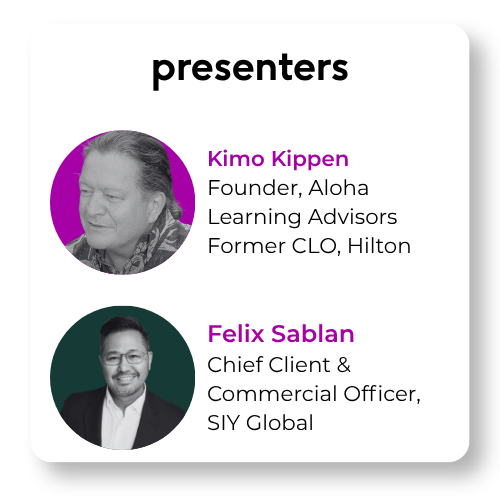
Thank you to Kimo Kippen and Felix Sablan for the insights.
Frequently asked questions
How do I tie leadership development to business outcomes? Start with the organization's purpose and strategic goals, not with a list of programs. Ask business leaders what success looks like in their own words, then define measures together. Every initiative should connect clearly to a business challenge it helps solve.
How do I get executive buy-in for leadership development? Name an executive sponsor for each initiative, and frame development as an investment rather than an expense. Succession readiness is a strong starting point, because most executives immediately see the risk of not having leaders ready for critical roles.
Should AI training take priority over leadership development? It doesn't have to be one or the other. AI adoption depends on human capabilities like self-awareness, adaptability, and a clear sense of purpose. Pairing AI skills training with leadership development makes both more effective and ties them to the same business outcome.
How should L&D prioritize when budgets are cut? Start by understanding why the budget changed. Then focus on the areas of greatest need and opportunity, which are usually senior leaders and future talent. Protect the initiatives most directly tied to the business's most urgent priorities.