

So many of the conversations we have about leadership development are intensely focused on the delivery and technology behind leadership development (especially with AI).
And while that’s a valuable part of the conversation, one of the things we’re not hearing enough about is actually questioning the underlying science of leadership development. Because if you don’t get that part right, everything else matters a lot less.
What most L&D teams don’t think about is just how old the models are that our leadership development programs are based on, and how much the science has changed. And while the delivery of leadership development has changed dramatically, the science underneath has not.
In this piece, we’ll take a look at behavioral training, which is the most common model that most leadership development programs are built on. We’ll explore the foundation of the model, how it became integrated into corporate leadership development, and where it’s falling short in today’s context.
A brief history of behavioral training in corporate leadership development
Before WWII, business leadership mostly ran on the Great Man Theory: the idea that leadership was a set of innate traits, present at birth, that emerged when the moment called for it.
The war changed that. Psychology was expanding fast, and the pressure to understand, categorize, and predict human performance under extreme conditions turned behavioral science into an applied discipline almost overnight. After the war, those lessons moved into corporate leadership, and the field of industrial-organizational psychology was born in 1945. The goal: break jobs down into discrete, observable, measurable behaviors.
That foundation was a huge advance because it proved one key thing: Leadership is a developable skill.
That opened the door for our entire professional field. And perhaps more importantly, it changed how organizations began to think more broadly about who had the potential for leadership.
Why organizations love the behavior model for leadership development
One of the most attractive things about the behavioral training model is that it puts the focus on results: how a leader behaves.
It’s an elegant approach that cuts through the messiness of human interactions. It doesn’t really matter what a leader’s personality is, or what they think and feel along the way. All that matters is that they show the right behaviors to perform.
The challenge, however, is that if you want to override all of those other things that influence behavior - what the leader observes, how they process information, how they feel, how they decide on the right behavior, etc. - you have to train every behavior thoroughly enough that it becomes an unconscious habit.
That can be done, but it takes a very specific formula to do it.
How It Works: The Formula for Behavior Change
The model for behavior change runs on a straightforward formula that looks like this:
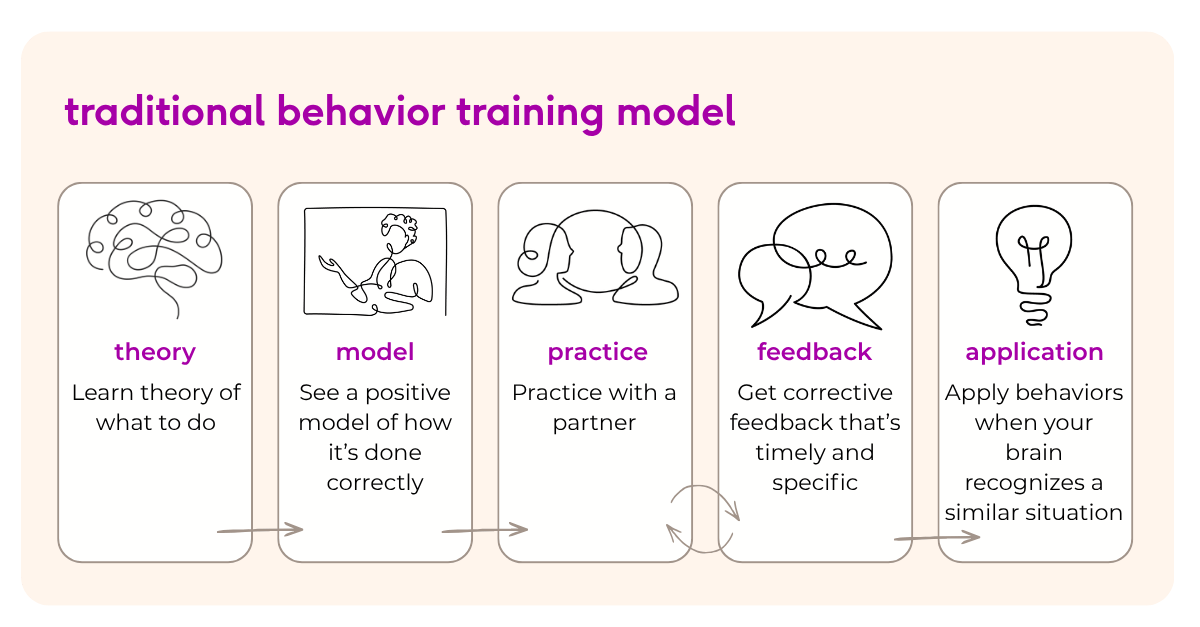
This runs on well-tested psychological principles and follows distinct steps:
- Teach the knowledge. This is the informational portion, where leaders learn the basic concepts behind each skill. This can be done either in the classroom, or in a flipped or blended learning model, this can easily be done through self-paced digital learning.
- Show a positive model. Show leaders what it looks like to perform the specific skill or behavior well.
- Practice the behavior. Have leaders practice the behavior, usually through role-play scenarios. Typically practice first happens in the classroom, but ideally they continue to practice on the job.
- Give them feedback. The leader needs to receive feedback that’s timely and specific to help them improve. In the classroom, this typically comes from a peer partner, but on the job, it should be coming from direct reports, peers, and/or the leader’s manager.
- Apply the skill. As the behavior becomes more routine, the leader begins to automatically recognize similar situations on the job, and the brain recalls the behaviors as the correct approach.
Note that the heart of this model is really in the practice and the feedback. This has to be a continuous cycle that happens over and over again to build the behavior into an automatic response.
But that’s also one of the model’s weaknesses that causes it to fail in practice.
DOWNLOAD EBOOK
Begin Upstream:
Designing effective leadership development in the era of change-fatigued skeptics
.png)
The Holes in the Behavioral Training Model
While the science and process of the behavioral training model are solid, the reality is that the implementation is much harder, especially at the pace of today’s business environment.
At SIY Global, our team has decades of experience working with organizations of all sizes on leadership development implementations. And pretty much every one struggles to create a system that meets the requirements of that approach.
Here are some of the reasons why:
This model builds habits through practice and repetition. It's the same principle behind training pilots, athletes, musicians, and military units. But those professions spend the overwhelming majority of their time in practice, with only a small fraction spent in actual performance. Leaders get the opposite. They're thrown into the role with little or no training and almost no time set aside to practice before it counts.
Behavior change requires feedback that's timely and specific. Leaders almost never get it. Direct reports hold back constructive feedback out of fear of retribution. A leader's own manager rarely observes the behaviors in question directly, and often only weighs in during a quarterly or annual review. And when feedback does show up, it's rarely specific enough to act on. "Work on your delegation" doesn't tell a leader which part of delegation is the problem.
For trained behavior to kick in, the brain has to recognize that a situation matches one it has encountered before. A pilot's training works because the emergency, however rare, still fits a pattern they've drilled. Leaders operating through constant change don't get that luxury. Each new disruption can feel entirely unfamiliar, which means the brain doesn't reliably reach for the trained response at all.
This model has to be applied behavior by behavior to work. Focus on one or two specific behaviors, and it holds up fine. But most leadership programs are building several competencies at once, each with three to five key behaviors attached. That adds up fast, often to a hundred or more behaviors a leader is supposed to be improving simultaneously.
Why This Matters Now
The behavioral model isn't wrong. But it is failing today’s leaders.
It was built for a more controlled, more repetitive environment than the one leaders operate in now. The pace, ambiguity, and constant change work against nearly every condition the model depends on to succeed.
That's why so many leadership programs look well-designed on paper, and change surprisingly little about what leaders actually do on the job.
So what does work when the conditions behavioral training needs aren't there anymore? The answer starts earlier in the process, before behavior even enters the picture.
Get the full picture in our free ebook, Begin Upstream: Designing effective leadership development in the era of change-fatigued skeptics. Inside, you'll find the neuroscience behind why the brain predicts before it reacts, and a five-step model built for the conditions leaders actually face today.